
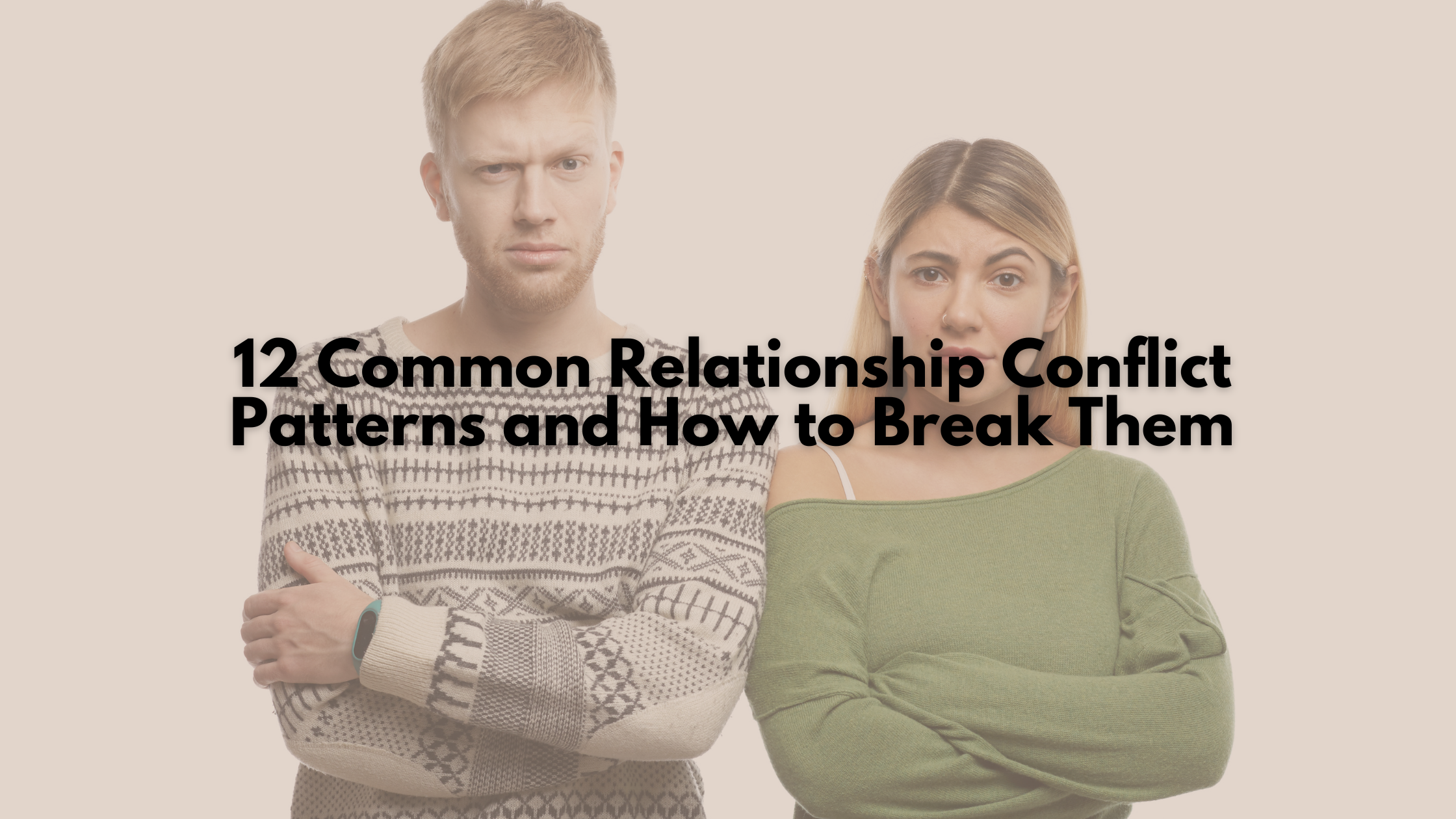
Have you and your partner had the same argument so many times that you already know how it will end? Maybe one of you pushes for answers while the other shuts down. Or a small disagreement quickly turns into criticism, defensiveness, or bringing up old mistakes.
When this keeps happening, the problem may not be the topic of the argument. It may be the pattern you both fall into when conflict starts.
These relationship conflict cycles can leave both partners feeling unheard, frustrated, distant, or emotionally exhausted. The good news is that recurring conflict patterns can change when both partners understand what is happening and learn different ways to respond.
In this guide, we’ll look at 12 common relationship conflict patterns, how they affect couples, and practical ways to start breaking the cycle.
Why Do Couples Keep Having the Same Arguments?

Have you ever had an argument and thought, “This has happened before”? That’s because most relationship conflicts follow familiar patterns.
We all develop automatic ways of reacting when we feel hurt, misunderstood, ignored, or overwhelmed. For example, one partner may push harder because they want to feel heard. The other may feel overwhelmed and pull away. The more one partner pushes, the more the other withdraws. Before long, both people are reacting to each other’s reactions.
Without realizing it, both partners repeat the same responses that create a cycle which is difficult to break.
Another reason conflicts keep coming back is that the real issue often stays unspoken. The arguments may be about small things like:
- Chores
- Tone of voice
- Punctuality
But underneath those arguments, there may be deeper concerns about feeling valued, respected, understood, or secure in the relationship.
Emotions also play a role in recurring patterns of conflict. It’s easy to react without thinking when things get heated up. When we feel hurt, we’re more focused on protecting ourselves than understanding our partner. This can prevent us from solving the real problem and keep repeating the pattern.
Over time, these repeated interactions can become habits. You begin to expect your partner’s reaction, and they expect yours. The conflict starts to feel predictable.
The important thing to remember is this: these patterns are learned. With awareness and small, intentional changes, they can be broken.
How to Know If You’re Stuck in a Conflict Cycle
You may be stuck in a repeating conflict cycle if the same reactions keep happening, even when the topic of the argument changes.
Some common signs include:
- You have the same argument about different topics.
- One person regularly shuts down while the other keeps pushing for answers.
- Small disagreements quickly become major arguments.
- One or both partners become defensive during difficult conversations.
- Old mistakes are repeatedly brought up.
- You apologize but the same problem keeps returning.
- You avoid certain topics because you already expect an argument.
- You feel more like opponents than partners during conflict.
- You understand your partner’s reaction before they even make it.
- Arguments leave both of you feeling emotionally exhausted.
If several of these patterns sound familiar, the issue may be less about finding the “right” argument and more about changing the cycle itself.
12 Common Relationship Conflict Patterns
Every couple handles conflict differently, but certain patterns show up again and again. You may recognize one of these patterns in your relationship, or you may notice several happening at the same time. Understanding the pattern is the first step toward changing how you both respond. Have a look:
1. The Pursuer–Withdrawer Pattern
One partner wants to talk about the problem right away, while the other needs space and pulls away. The more one partner pushes for answers, the more the other withdraws.
This can leave both people feeling misunderstood. The partner who wants to talk may feel ignored, while the partner who withdraws may feel pressured or overwhelmed.
How to break it:
Instead of chasing the conversation or completely shutting it down, agree on a short break and a specific time to return to the conversation. The partner who needs space can say, “I need 30 minutes to calm down, but I want to talk about this tonight.” This creates space without turning withdrawal into avoidance.
2. The Criticism–Defensiveness Cycle
When concerns are expressed as criticism towards each other, the natural response is defensiveness.
Instead of resolving the issue, the conversation turns into protecting oneself.
How to break it:Focus on the specific behavior and how it affects you instead of attacking your partner’s character. Instead of saying, “You never listen to me,” try, “I felt unheard when I was talking and you looked at your phone.” This gives your partner something specific to understand and respond to.
3. The Scorekeeping Pattern
Keeping track of who did more, who apologized first, or who caused the bigger problem can slowly turn a relationship into a competition. Instead of solving the current problem, both partners start collecting evidence against each other.
How to break it:
Stop trying to prove who has done more wrong. Focus on the current problem and what would help repair it. If old resentment keeps coming up, set aside time to address it instead of bringing every past mistake into new arguments.
4. The Blow-Up and Apologize Pattern
Some couples avoid difficult conversations because they do not want to create tension. The problem is that frustration does not always disappear when it is ignored. It can build until one small issue leads to a much bigger argument.
How to break it:
Bring up concerns while they are still manageable. You do not need to solve everything immediately. Even saying, “Something has been bothering me, and I’d like to talk about it later tonight,” can prevent resentment from building silently.
5. The Emotional Shutdown Pattern
When things feel too intense, one partner emotionally checks out, going quiet, distant, or unresponsive.
To the other partner, this can feel like they’re being ignored.
How to break it:Notice when either partner is becoming overwhelmed and agree to take a short break. Before stepping away, agree on when you’ll return to the conversation. This gives both partners time to calm down without leaving the issue unresolved.
6. The Fix-It vs Feel-It Pattern
One person tries to solve the problem right away, while the other simply wants to be heard.
Both leave the conversation feeling dissatisfied.
How to break it:
Before offering advice, ask, “Do you want me to listen, or would you like help finding a solution?” Sometimes feeling understood needs to come before problem-solving.

7. The Avoidance Pattern
Avoiding conflict can feel peaceful in the short term, but unresolved problems often return later. Over time, partners may stop talking about important needs, expectations, or concerns altogether.
How to break it:
Start with smaller conversations instead of waiting until everything feels overwhelming. Choose a calm time to discuss one issue at a time and focus on understanding rather than winning.
8. The Parent–Child Dynamic
One partner starts taking responsibility for everything, while the other becomes increasingly dependent on them. This can create a parent-child dynamic where one person feels overburdened and the other feels criticized, controlled, or treated as incapable.
How to break it:Look for ways to share responsibilities and decisions more equally. Instead of one partner automatically taking charge, discuss what each person can realistically handle.
9. The Assumption Loop
Instead of asking what their partner meant, one person assumes they already know. A short reply becomes “They’re angry with me.” A forgotten task becomes “They don’t care about me.” These assumptions can turn uncertainty into conflict.
How to break it:
Replace assumptions with questions. Before reacting, ask what your partner meant or what was happening for them. A simple question can prevent a misunderstanding from becoming a larger argument.
10. The Past-Replay Pattern
Old arguments and mistakes keep resurfacing during new disagreements.
It can feel like nothing is ever truly resolved.
How to break it:
Ask whether the old issue has actually been resolved. If it has not, give it its own conversation instead of using it as ammunition during every new disagreement. If the same hurt keeps returning, couples therapy can help you work through what has not been repaired.
11. The Stress Spillover Pattern
Work pressure, financial worries, parenting responsibilities, lack of sleep, or major life changes can make both partners more reactive. As stress builds, a small disagreement at home can feel much bigger than it normally would.
How to break it:
Notice when outside stress is affecting the relationship. Instead of blaming your partner for your frustration, name what is happening: “I’m having a stressful day, and I don’t want that to come between us.” Small moments of connection can help both partners reset.
12. The Disconnection–Reconnection Cycle (Without Repair)
After an argument, couples may return to normal without actually talking about what happened. The immediate tension disappears, but hurt feelings or unanswered questions remain underneath.
How to break it:
Make emotional repair part of the conflict process. Talk about what happened, acknowledge each other’s feelings, and discuss what you can both do differently next time. Repair does not require a perfect apology. It means making a genuine effort to understand the hurt and reconnect.
What Happens When Conflict Patterns Keep Repeating?
Repeating conflict can affect much more than the arguments themselves. Over time, the cycle can change how safe, connected, and understood both partners feel in the relationship.
You may notice:
- Feeling anxious before difficult conversations
- Avoiding topics that matter to you
- Feeling unheard or misunderstood
- Resentment building over time
- Less emotional or physical closeness
- Repeated apologies without lasting change
- Feeling like you are on opposite sides
These signs do not automatically mean that a relationship is failing. They may simply mean that the current way of handling conflict is not working.
When Conflict Goes Beyond Communication Problems
Not every relationship conflict is simply a communication issue. If disagreements involve threats, intimidation, physical violence, coercion, or fear for your safety, the situation may require a different kind of support. Couples therapy may not be appropriate in every situation, especially when one partner does not feel safe speaking openly.
How Couples Therapy Can Help Break Repeating Conflict Cycles
It can be exhausting when the same arguments keep repeating. You start thinking, “Why do we always end up here?”
The truth is, it’s not just the conflict, it’s the pattern behind it. That’s exactly what therapy helps you understand.
A couples therapist isn’t there to decide who is right or wrong. Instead, they help both partners understand the pattern and find healthier ways to respond.
Identify the Pattern Behind the Arguments
Instead of focusing only on the latest disagreement, therapy helps couples understand what happens before, during, and after the conflict. You can begin to see the cycle both partners are caught in.
Understand What Each Partner Needs
Partners may experience the same situation very differently. Therapy creates space for both people to explain what they are feeling and what they need without turning the conversation into another argument.
Learn Healthier Ways to Communicate
Couples can practice expressing concerns clearly, listening without immediately becoming defensive, and slowing down conversations before emotions take over.
Work Through Trust and Emotional Distance
Repeated conflict can create hurt and distance over time. Therapy can help couples address those underlying concerns instead of repeatedly arguing about the same surface-level issue.
Create Practical Changes Outside Therapy
The goal is not simply to have better conversations during sessions. Couples can work toward practical changes they can use at home when disagreements happen again.
How Dr. Christopher Joaquim Helps Couples Break Conflict Cycles
When the same conflict keeps happening, it can be difficult to see the pattern from inside the relationship. Dr. Christopher Joaquim brings more than 21 years of experience working with couples and relationship concerns.
His couples therapy focuses on helping partners understand the patterns behind repeated conflict, communicate more clearly, rebuild trust, and make practical changes that can carry into everyday life. His approach draws from evidence-based methods, including Cognitive Behavioral Therapy (CBT), relational and interpersonal therapy, mindfulness-based strategies, solution-focused therapy, and strength-based psychology.
Depending on your concerns, therapy may help you understand why arguments keep repeating, identify emotional triggers, communicate more clearly, work through unresolved hurt, or rebuild connection after a difficult period.
The goal is not to decide which partner is right. It is to help both partners understand the pattern, make meaningful changes, and create a healthier way of handling conflict.
Conclusion
The goal isn’t to stop arguing. It’s to stop getting stuck in the same argument.
When you understand the pattern behind your conflicts, you can start responding differently, listening more openly, and repairing the hurt before it grows.
If you and your partner have tried to break the same pattern on your own but keep ending up in the same place, couples therapy can provide a structured, neutral space to work on the pattern together. Dr. Christopher Joaquim offers couples therapy for partners dealing with repeated conflict, communication problems, emotional distance, trust concerns, and other relationship challenges.
A better relationship doesn’t require perfect communication. It starts with both partners being willing to break the pattern.
Frequently Asked Questions
Why do couples keep having the same arguments?
Couples may keep having the same arguments because the underlying conflict pattern is never addressed. One partner may push for answers while the other withdraws, or both partners may become defensive instead of talking about what they actually need.
How can I tell if my relationship has a conflict cycle?
You may be stuck in a conflict cycle if you have the same arguments repeatedly, avoid certain conversations, bring up old problems, or notice that you and your partner react to each other in predictable ways.
How can couples stop repeating the same arguments?
Couples can start by identifying what happens before, during, and after an argument. Slowing down heated conversations, expressing needs clearly, asking questions instead of making assumptions, and repairing after conflict can help change the pattern.
What should I do when my partner shuts down during an argument?
If your partner becomes overwhelmed, give them some space to calm down without abandoning the conversation completely. Agree on a time to return to the issue so that taking a break does not become a way of avoiding the problem.
Why do small disagreements turn into big arguments?
Small disagreements can become bigger when they connect to deeper feelings such as feeling ignored, criticized, rejected, or unappreciated. Once both partners become emotionally overwhelmed, the original issue can quickly turn into a larger conflict.
Can couples break unhealthy relationship patterns?
Yes. Couples can learn to recognize unhealthy conflict patterns and develop better ways to communicate, listen, manage difficult emotions, and repair after disagreements. Some couples make these changes on their own, while others benefit from couples therapy.
When should couples consider therapy for recurring conflict?
Couples may want to consider therapy when the same arguments continue despite attempts to resolve them, communication has become difficult, resentment is building, or both partners feel emotionally disconnected. Therapy can also be helpful before problems become more serious.
Can couples therapy help with repeated arguments?
Yes. Couples therapy can help partners identify the patterns behind repeated arguments, understand each other’s needs, improve communication, work through unresolved hurt, and develop healthier ways of responding during conflict.
What is the most common conflict pattern in relationships?
There isn’t one conflict pattern that applies to every couple. Common patterns include one partner pursuing a conversation while the other withdraws, criticism followed by defensiveness, avoidance, scorekeeping, and repeated unresolved arguments.
Can a relationship improve if only one partner changes?
One person’s changes can affect the relationship dynamic, but lasting improvement often requires both partners to participate. Individual therapy can also help when one partner wants support understanding their own reactions, boundaries, or communication patterns.