
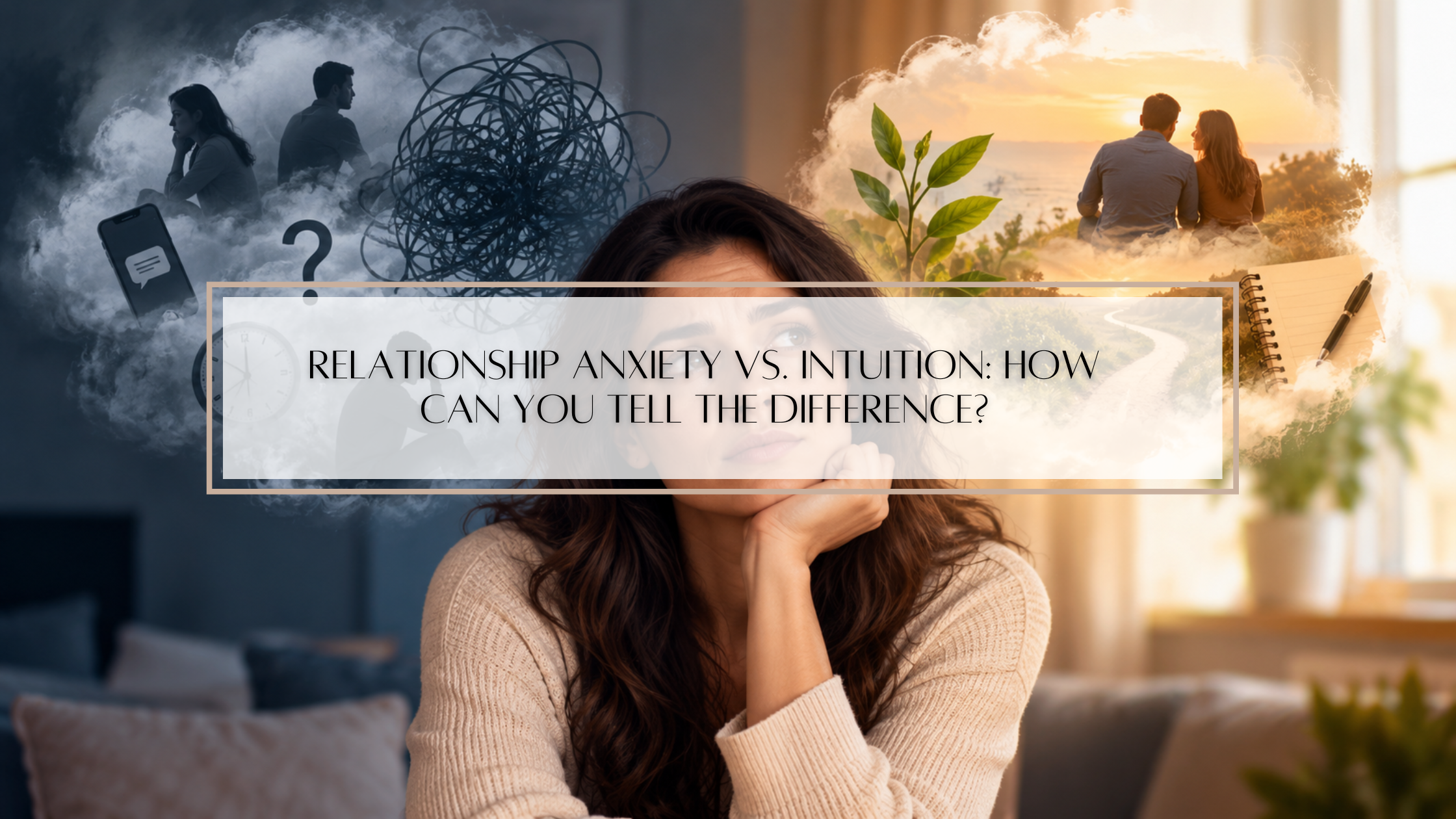
Have you ever felt that something is wrong in your relationship but struggled to explain why? Perhaps your partner seems quieter than usual, and you start wondering whether they’re losing interest. You might question whether your gut is warning you about a real problem or whether anxiety is making you overthink the situation.
The difference isn’t always obvious. Relationship anxiety often involves fear-driven thoughts and repeated doubts, while intuition may draw your attention to changes you haven’t fully understood. However, neither feeling is always accurate. This article explores the signs of each, how past experiences influence your perceptions, and practical ways to assess your concerns without dismissing your feelings or jumping to conclusions.
What Does Relationship Anxiety Usually Feel Like?
Relationship anxiety involves persistent worry about the stability of your relationship, your partner’s feelings, or the possibility of being rejected.
You might know that your partner cares about you but still struggle to believe it when something feels different.
Common signs include:
- Overanalysing everyday interactions: Replaying conversations to determine whether your partner sounded annoyed or distant.
- Seeking repeated reassurance: Asking whether your partner still loves you, even after they’ve expressed affection.
- Expecting the relationship to fail: Worrying that a good relationship will eventually end without a clear reason.
- Interpreting small changes negatively: Assuming a delayed reply or cancelled plan means your partner is losing interest.
- Struggling to enjoy the present: Spending more time worrying about a possible breakup than enjoying your relationship as it is.
For example, your partner might be tired and less talkative one evening. You understand that they’ve had a long day, but you still worry that their feelings have changed.
Anxiety can make an uncertain situation feel threatening even when you don’t have enough information to understand what’s happening.
To compare this with intuition, it helps to examine what people mean when they describe a gut feeling.
How Can Intuition Feel Different From Anxiety?
Intuition is often described as an immediate sense that something deserves attention, even before you can fully explain why. It may reflect your brain recognising patterns or noticing details you haven’t consciously considered.
For example, you might notice that your partner repeatedly avoids conversations about your future. You may not know what this means, but you recognise that the pattern needs discussing.
A feeling that resembles intuition may involve:
- Noticing specific changes: Recognising differences in behaviour, communication, or follow-through.
- Sensing an unresolved concern: Feeling that something needs clarification, even when you cannot yet explain it fully.
- Wanting to investigate rather than assume: Asking questions or looking for more information before reaching a conclusion.
- Remaining open to new information: Being willing to reconsider your interpretation as you learn more.
However, intuition is not proof that something is wrong. Past hurt, fear, and unconscious assumptions can also influence gut feelings.
A strong feeling may be worth examining, but it cannot tell you with certainty whether your partner is dishonest, losing interest, or hiding something.
Since anxiety and intuition can overlap, comparing the evidence behind each feeling is more useful than judging how convincing it seems.
How to Compare Anxiety and Intuition More Clearly
Neither anxiety nor intuition has a single, unmistakable pattern. Instead, look at what triggered the feeling, what evidence supports your concern, and whether you can consider other explanations.
| What to examine | When anxiety may be involved | When a specific concern needs investigating |
| Trigger | Uncertainty or fear of rejection | A noticeable change or recurring behaviour |
| Thoughts | Repeated “what if” questions | Questions about a specific inconsistency |
| Evidence | Assumptions based on limited information | Observable events that can be discussed |
| Response to reassurance | Relief fades and doubt returns | The underlying issue remains unresolved |
| Response to new information | New doubts replace earlier ones | Your understanding changes as facts emerge |
These are useful patterns to consider, not a diagnostic test. Anxiety can respond to real relationship problems, and an apparently reasonable concern can still be based on incomplete information.
Consider this example: your partner has become less affectionate recently.
- An anxiety-driven interpretation: “They’re not as affectionate as before. They must be falling out of love with me.”
- A more balanced interpretation: “I’ve noticed we’ve been less affectionate lately. I wonder whether something has changed, and I’d like to talk about it.”
The second response acknowledges the change without assuming its meaning. It gives you an opportunity to understand the situation before deciding what it says about your relationship.
Your interpretation of present events can also be influenced by experiences from previous relationships.

How Past Experiences Can Influence Your Relationship Fears
Previous experiences can shape how you respond to uncertainty. If you’ve experienced betrayal, rejection, or an unexpected breakup, you may become more alert to signs that a relationship could be in trouble.
This sensitivity can sometimes help you notice concerning behaviour. It can also lead you to interpret ordinary situations as threats. The Cleveland Clinic’s guide to working through trust issues explains how past hurt can affect trust in future relationships.
For example:
- After infidelity: You may feel uneasy when your partner is protective of their phone, even without other evidence of dishonesty.
- After an unexpected breakup: You may interpret a request for space as a sign that your current partner is preparing to leave.
- After repeated criticism: You may assume your partner is angry whenever their tone changes.
- When you struggle with self-worth: You may interpret a difference in affection as evidence that you aren’t good enough.
Attachment patterns can also influence how you experience emotional closeness. Someone who fears rejection may be especially sensitive to distance, while someone who finds vulnerability difficult may feel uneasy as a relationship becomes more intimate.
These reactions don’t mean your concerns are imaginary. They mean that understanding the present situation may require separating what is happening now from what you fear could happen again.
Once you recognise these influences, you can use practical steps to assess your concerns more clearly.
Practical Ways to Evaluate Your Relationship Concerns
You don’t have to decide immediately whether a feeling is anxiety or intuition. Instead, give yourself time to understand what triggered it and whether there is a genuine issue to address.
1. Describe What Happened Without Assuming Why
Start with the observable event rather than your interpretation of it.
For example:
- Instead of “My partner is losing interest,” write, “My partner has cancelled our last two plans.”
- Instead of “They’re hiding something,” write, “They gave me different explanations about the same event.”
- Instead of “They’re angry with me,” write, “They’ve been quieter than usual today.”
This helps you distinguish what you know from what you’re trying to explain.
2. Examine the Evidence Behind Your Fear
Ask yourself:
- What evidence supports my concern?
- Am I relying on one incident or a repeated pattern?
- Could there be another reasonable explanation?
- What information would help me understand the situation better?
You don’t need to dismiss your concern or convince yourself that everything is fine. The aim is to reach a conclusion based on more than fear alone.
3. Notice Whether You Keep Seeking Certainty
If you repeatedly check messages, replay conversations, or ask your partner the same questions, consider whether these actions genuinely resolve your concerns.
Individual therapy may be helpful if you:
- Experience recurring anxiety that is difficult to manage.
- Struggle to sleep or concentrate because of relationship worries.
- Find that anxiety interferes with daily activities or relationship functioning.
- Feel caught in repetitive checking or reassurance-seeking patterns.
A therapist can help you identify your triggers and develop healthier ways to manage uncertainty and emotional distress.
4. Discuss Specific Changes With Your Partner
If a concern persists, raise it without accusing your partner of something you haven’t established.
You could say, “I’ve noticed we’ve had less time together lately, and I’m missing that connection. Is something making it difficult for us to spend time together?”
A direct question gives your partner an opportunity to explain their perspective and allows you to discuss the issue together.
For more practical communication strategies, read Dr. Christopher Joaquim’s article on 9 best practices to be a better listener in your relationship.
5. Pay Attention to Patterns Over Time
One awkward conversation or unusual day doesn’t necessarily tell you much about the health of a relationship.
However, repeated dishonesty, broken agreements, disrespect, or refusal to address important concerns deserve attention. Notice whether your partner listens, follows through, and treats your concerns seriously over time.
If your concerns persist or begin affecting your well-being, professional support may help you understand your reactions and decide what to do next.
When Should You Take Your Gut Feeling Seriously?
Taking a concern seriously doesn’t mean assuming your worst fear is true. It means paying attention to observable behaviour and deciding whether it needs to be addressed.
Consider looking more closely at patterns such as:
- Repeated inconsistencies: Your partner’s explanations frequently contradict what you observe.
- Broken commitments: They repeatedly fail to follow through on agreements without addressing the impact.
- Persistent disrespect: They mock your concerns, dismiss your feelings, or refuse to discuss important issues.
- Boundary violations: They continue behaviour you’ve clearly explained is unacceptable to you.
- Intimidation or coercion: You feel threatened, controlled, or afraid of your partner’s reaction.
These behaviours don’t prove every suspicion you might have, but they provide concrete reasons to evaluate the relationship.
You don’t need absolute certainty about your partner’s intentions before setting boundaries or seeking support. If you feel unsafe, prioritise your safety rather than trying to determine whether your fear is anxiety or intuition.
When uncertainty repeatedly affects your relationships, therapy can offer a structured way to explore your concerns.
How Therapy Can Help You Understand Relationship Fears
Relationship anxiety can be difficult to manage when doubts return despite reassurance or when past experiences influence how you interpret your partner’s behaviour.
Therapy can help you examine your reactions without assuming that every concern is irrational or that every gut feeling is accurate.
Depending on your needs, therapy may involve:
- Examining anxious thoughts: Identifying assumptions and learning to evaluate them against available evidence.
- Understanding emotional triggers: Exploring how earlier experiences influence your responses to uncertainty, conflict, or emotional distance.
- Managing uncertainty: Learning to tolerate uncomfortable feelings without repeatedly checking or seeking reassurance.
- Improving communication: Practising ways to raise concerns without accusations or avoiding difficult conversations.
- Evaluating relationship patterns: Distinguishing anxiety-driven fears from recurring behaviours that may require boundaries or practical changes.
Individual therapy can help you understand your own reactions. Couples therapy may be useful when both partners want to address communication difficulties or recurring conflict.
For more information about how anxiety can affect everyday life and relationships, see the American Psychological Association’s guide to anxiety disorders.
For couples who find themselves caught in repeated cycles of suspicion, reassurance, or misunderstanding, a therapist can help them examine those patterns together.
How Dr. Christopher Joaquim Helps Couples Find Clarity
Dr. Christopher Joaquim has over 21 years of clinical experience and uses therapeutic approaches including Cognitive Behavioral Therapy (CBT), Mindfulness, Strength-Based Therapy, and Solution-Focused Therapy.
When relationship anxiety contributes to recurring conflict, therapy can help couples examine how they interpret each other’s behaviour and respond to uncertainty.
Depending on the couple’s circumstances, the work may include:
- Examining assumptions through CBT-informed strategies: Exploring thoughts such as “If my partner seems distant, they must be losing interest” and considering what the available evidence supports.
- Recognising emotional reactions: Using mindfulness-based techniques to notice anxiety or defensiveness before responding automatically.
- Addressing recurring disagreements: Identifying how misunderstandings develop and what each partner can do differently.
- Finding practical ways forward: Using solution-focused strategies to identify realistic changes that address the couple’s specific concerns.
The goal isn’t to label every worry as anxiety or treat every gut feeling as proof. It is to help couples understand their concerns, communicate more clearly, and make informed decisions about their relationship.
If relationship anxiety or recurring uncertainty is affecting your connection, explore Dr. Christopher Joaquim’s couples therapy to learn more about the available support.
Final Thoughts
Relationship anxiety and intuition can feel similar, but neither should be judged by the strength of the feeling alone. Look at what triggered your concern, whether observable patterns support it, and how your understanding changes when you gather more information.
You can acknowledge anxiety without dismissing genuine problems, and you can take a gut feeling seriously without treating it as proof. If uncertainty repeatedly affects your trust or leads to conflict, Dr. Christopher Joaquim’s couples therapy services can help you explore these patterns and work towards clearer communication and more confident relationship decisions.
Frequently Asked Questions About Relationship Anxiety and Intuition
Can anxiety feel exactly like intuition?
Yes. Anxiety can create a strong sense that something is wrong, especially when uncertainty triggers past fears. The feeling alone cannot establish whether a concern is accurate; examining evidence and patterns is more useful.
Can your intuition be wrong about your partner?
Yes. A gut feeling can reflect incomplete information, previous hurt, or assumptions rather than an accurate assessment. Treat it as a reason to pay attention, not as proof that your partner has done something wrong.
Should I trust my gut if I have relationship anxiety?
Take the feeling seriously without automatically accepting its conclusion. Identify what triggered it, examine observable behaviour, and consider alternative explanations before deciding whether a conversation or boundary is needed.
Why do I feel anxious when my relationship is going well?
Closeness can bring vulnerability, particularly if you fear losing someone important. You may start anticipating problems even when things are going well. This doesn’t mean the relationship is secretly unhealthy or doomed.
Can relationship anxiety cause me to overthink harmless behaviour?
Yes. Anxiety can make ordinary events, such as a delayed reply or a tired tone, seem threatening. Separating observable facts from assumptions can help you avoid reacting to conclusions that remain uncertain.
How do I know if a concern is a red flag?
Look for repeated, observable behaviours such as dishonesty, disrespect, broken agreements, or boundary violations. A single ambiguous incident may need clarification, while persistent patterns deserve attention regardless of whether anxiety is also present.
Can therapy help me distinguish intuition from anxiety?
Therapy can help you recognise emotional triggers, evaluate interpretations, and tolerate uncertainty. It cannot guarantee that every instinct will be classified correctly, but it can support more thoughtful decisions based on feelings and evidence.
Should I confront my partner whenever something feels wrong?
Not necessarily. First identify what happened and whether the concern persists. If there is a specific issue, raise it calmly and directly. Avoid treating an anxious suspicion as established fact before discussing it.